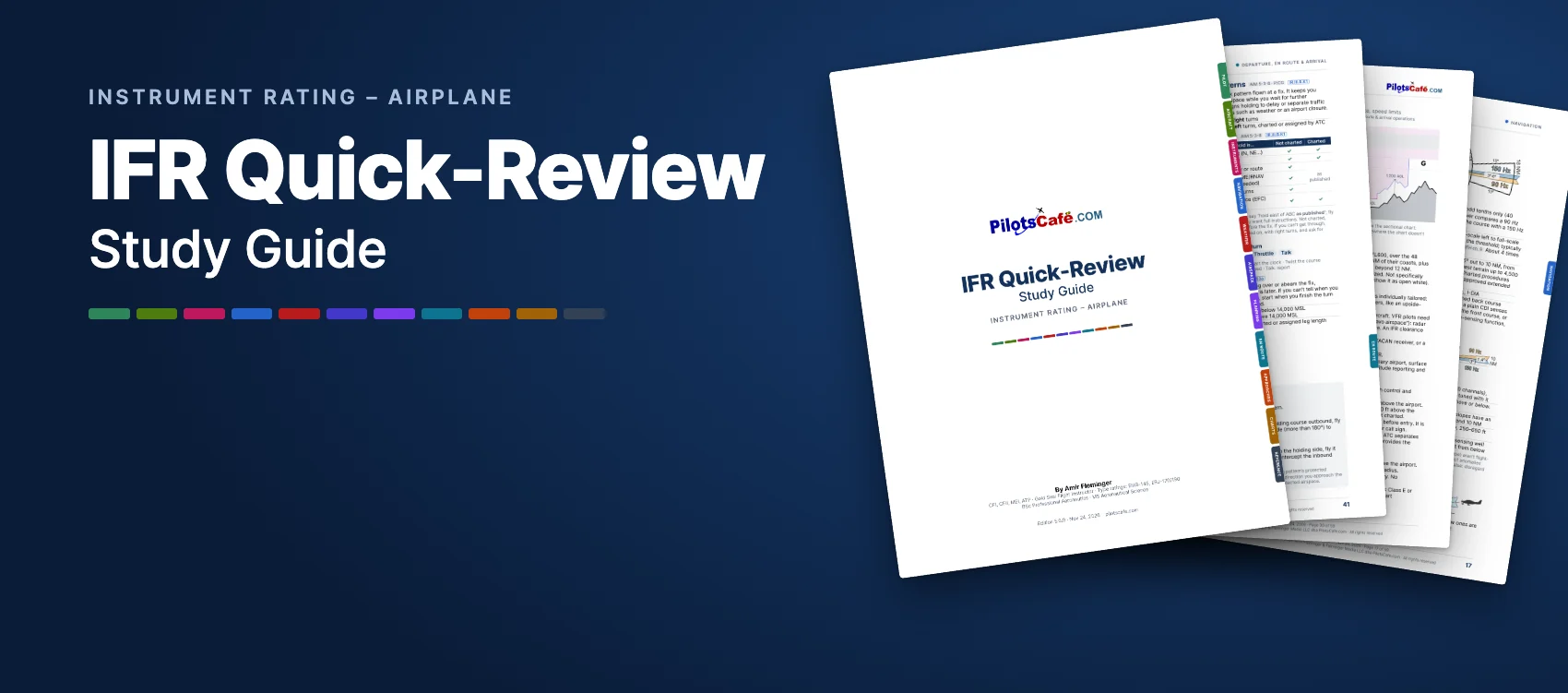
Review for your instrument checkride from one 59-page PDF.
The PilotsCafe IFR Quick-Review Study Guide covers the FAA instrument rating for airplanes: the regulations, procedures and numbers your examiner will ask about, laid out in tables, flowcharts and mnemonics so you can find an answer in seconds.
The instrument rating draws on Parts 61 and 91, the AIM, the FAA handbooks and the chart legends. This guide puts what you need for the oral and the flight in one place, in the order of a flight. Your last weeks of review go to recalling and practicing, not to searching.
It doesn't replace the FAA handbooks or your instructor. It is the summary you review after you have studied them. I wrote the first version for my own students, and thousands of pilots have used it and sent feedback since.
Use it if you are:
an instrument student preparing for the oral and the checkride, or
a rated pilot getting current again or preparing for an IPC.
New in edition 5.0.0
I rebuilt the guide from the ground up and expanded it from 36 to 59 pages.
A new design, built for scanning: tables where there used to be paragraphs, and a summary before the details.
Eleven chapters that follow the order of a flight, with color tabs, a contents page and PDF bookmarks.
Instrument Rating ACS codes on the sections that cover them, so you can study by task.
New sections on unusual attitudes, partial panel, autopilot and automation, and CDFA.
Every section checked against current official sources: 14 CFR, the AIM, the FAA handbooks and the ACS.
Regulations, AIM paragraphs and handbook chapters that link to the source.
A list of every mnemonic in the guide, with its page.
What's inside
Pilot: when you need an instrument rating, the experience required for it, logging instrument time, staying current, decision making, aeromedical factors, spatial disorientation and illusions, pilot documents.
Aircraft: aircraft documents, inspections for IFR, required equipment, inoperative equipment, the instrument preflight and taxi check.
Instruments & Attitude Flying: gyroscopic and pitot-static instruments, the magnetic compass, electronic flight instruments, attitude instrument flying, unusual attitudes, partial panel.
Navigation: VOR, DME, NDB, ILS, GPS, RNAV, PBN and RNP, intercepting and tracking, DME arcs, autopilot and automation.
Weather: weather sources, in-flight advisories, reports and forecasts, decoding METAR and TAF, charts and imagery, turbulence and wind shear, thunderstorms, icing, fog.
Airspace: airspace classes, basic VFR weather minimums, special use airspace, speed limits.
Flight Planning: preflight and the IFR flight plan, minimum IFR altitudes, cruising altitudes, alternates and fuel.
Departure, En Route & Arrival: takeoff minimums, departure procedures, clearances, briefings, STARs, required reports, holding patterns, lost communications.
Approaches: approach segments, procedure turns, approach types, the missed approach, RNAV (GPS) lines of minima, descending below DA or MDA, circling, VDP, CDFA.
Chart Legend: approach chart planview and profile symbols, landing minimums, the IFR en route chart, approach light systems, visual glideslope indicators.
Reference: abbreviations and terms, and the mnemonics list.
Built for quick review
Mnemonics are set as letter tiles, each letter beside what it stands for.
Flowcharts walk you through the decisions people get wrong under pressure: whether you need an alternate, what to do after lost communications, whether you can fly with inoperative equipment.
Each rule carries its reference (for example, §91.175 or AIM 5-4-21). Click it to read the source.
The contents page, the bookmarks and the color tab on each page edge take you to a chapter in one step.
Pay what you want
Suggested price: $15.
That is less than half the cost of one ground lesson, for a guide that can save you hours of review. Enter any price, including $0 if you can't afford it right now.
If you pay and the guide doesn't help you, email me and I'll refund you in full, no questions asked.
Pilots who pay tell me they do it to support the hours that go into each update and to keep the guide available to everyone.
5% of the guide's profits go to Direct Relief each year. Direct Relief provides medical aid worldwide and is one of Charity Navigator's top-rated charities.
Download the guide now and review the first chapter tonight.
When a new edition comes out, the file in your Gumroad library is replaced with it. You don't pay again. Download the latest edition from your Gumroad library.
New graphic for odd/even flight altitude sectors in controlled airspace.
Updated AIM reference. AIM 5-1-8 replaced with 5-1-6
Updated NOTAM definition
Special Thanks
Andrew Shacker
Ben Bratcher
Nadeem Toor
v3.7.0 (17 Nov 2022)
Added warning about IMC in class G without clearance.
Added information about cruise clearances and block altitudes.
Typographical and formatting fixes
Holding pattern race track drawing - minor graphical fix
v3.6.2 (08 Oct 2022)
Changed "IAP" to "IAF" in "starting at the IAP", page 2.
Add references to §61.57 in carrying passengers as PIC and instrument recency sections, page 1.
Fixed FAR reference to class B to §91.131, page 17.
VDA, change "Visual Descent Angle" to "Vertical Descent Angle".
Added GLS, SFRA, VDA, and VDP to glossary.
Special thanks:
Martin Kelly
Dan Sobczak
v3.6.1 (16 May 2022)
Rephrased optical illusion section for clarity.
Fixed: RNAV routes by default are RNAV 2, not RNAV 1 as stated previously.
ILS Categories: Added reference to AIM 1-1-9 and added the word "Lowest" to ILS CAT visibility and DH column headers for clarity.
Clarified instrument recency timeline graphic. This is a work in progress and may be improved further to be more concise.
Special thanks:
Bryce Spain
Doug Blischok
v3.6.0 (30 Jan 2022)
IFR Altitudes
Added descriptions for MCA and MRA definitions.
Lost Comm Procedures
Added in VFR conditions, continue the flight under VFR and land as soon as practicable.
Improved formatting
DME slant range explanation reworded
Remove reference to §61.51 in "When is an instrument rating needed" (it belongs only to "Logging Instrument Time")
Typo corrections
Special thanks:
Dave Dwyer
James Mahoney
Justin Jackson
Robert Haymond
v3.5.1 (11 Nov 2021)
More typo corrections
'other mean available' -> 'other means available'
'pop-ups are a mean to' -> 'pop-ups allow'
cancelled -> canceled
floatation -> flotation
minimas -> minima
scaleable -> scalable
Special thanks:
Chris Higgins
v3.5.0 (11 Nov 2021)
New: when can a pilot log instrument approaches.
Departure procedures:
New: Vertical Climb Over Airport (VCOA)
New: Diverse Departure Criteria and procedures
New: Diverse Vector Area procedures
Clarified description of Scalable RNP.
Changed "Mandatory reports under IFR" to "Required ..."
Changed "Types of class E" to "Functions of ..." to match AIM's language.
Added two more functions of class E.
Typos
Replace "Orthographic" with "orographic" lifting
Replace "uplosping" with "upsloping"
Terms and definitions
New: Night definition as per FAR 1.1
New: VCOA definition
Minor design and formatting improvements
Special thanks:
Eric Treworgy
Graeme Nichol
Jack Spellman
Michal Harel
v3.4.0 (29 Sep 2021)
Added DME Service Volumes
Fixed formatting and typos
Special thanks:
Diego Luna
William D. Palmer
v3.3.0 (13 Aug 2021)
Rephrased recency of experience section and added exceptions.
Rearranged first few pages of the guide to fit added content.
Added graphic for IFR recency of experience timeline.
Added 'A PTA TEN R' acronym for position reports.
Removed periods from acronyms
Fixed typo decent to descent
v3.2.0 (19 Jul 2021)
Added DME service volumes
Rearranged page
Fixed formatting and typos
v3.1.0 (17 May 2021)
Added information about pop-up IFR clearances.
Added types of weather briefings.
Added remark in "operating with inoperative items" that removing equipment affects W&B.
Added transponder code table.
Fixed typos.
v3.0.0 (28 Feb 2021)
Changed copyright - guide is now under the "pay what you want" price model $0+.
Formatting
v2.6.0 (26 Feb 2021)
Added "When is an Instrument Rating required?" paragraph.
Fixed text formating
Re-arranged first page layout
Special thanks: Dan Watkins
v2.5.1 (17 Feb 2021)
Fixed typos and minor text editing
v2.5.0 (25 Jan 2021)
Added sections about airspace and special use airspace.
Reformat design of weather section.
v2.4.1 (18 Dec 2020)
Fixed typo in example of descent planning calculation (replaced FL320 with FL350)
Special thanks: Ian Clark
v2.4.0 (16 Dec 2020)
Changed bank angle calculation for standard-rate turns from (KTAS / 10) + 5 (which is only correct for 100kts) to (KTAS / 10) x 1.5
Reports required in non-radar environment to reflect a change in section 5-3-3 of the AIM.
ETA ±3 minutes changed to 2 min, or 3 min if in North Atlantic (NAT). This reflects a change made in the AIM.
Added QR Code for quick access to the updates page.
Special thanks: Ian Mastenbrook
v2.3.1 (14 Dec 2020)
Fixed typo in IFR Cruising Altitude graphics. Replaced 170º with 179º.
Special thanks: Ian Clark
v2.3.0 (10 Dec 2020)
Special thanks:
Captain (ret.) Phil Remmel, DPE of Scottsdale, AZ, for the many improvements, most specifically the revision of the AVIATES acronym.
Mahbubur Khan for pointing to the error in hyperventiation wording.
Replaced required inspections menemonic AVIATE with AVIATES.
Re-arranged meaning of letters in the acronym.
Added STC and AD's required inspections to the
Added progressive inspections
Clarified wording
Added examples of when 100 hours inspection is required or not.
Added Taxi Briefing (ARCH)
IFR Cruising Altitudes
Added details about IFR altitudes in controlled vs. uncontrolled airspace.
Rephrased Altimeter taxi check.
Min equipment required for IFR
Replaced "two-way navigational equipment appropriate for the route to be flown" with "two-way communication & navigational radios appropriate for the route to be flown"
Corrected DME requirements above FL240 to "at and above FL240".
Clock: added "... with sweep-second pointer or digital representation"
Basic VFR Weather Minimums section
Replaced Class E "above 10,000' MSL" with "at or above 10,000' MSL"
Replaced Class G "above 10,000'" with "at / above 10,000' MSL"
Replaced Class G "below 1,200' AGL" with "at or below 1,200' AGL"
Oxygen requirements
Replaced that "12,500'-15,000' (including)" with "above 12,500 to 14,000’ MSL (including)"
Terms & Definitions
Added AD, STC, RVSM
Improved formatting
Fixed wording of hyperventilation definition.
v2.2.0 (07 Dec 2020)
Added info about VOR Minimum Operational Network program (MON) and new VOR service volumes graphic.
Terms & Definitions
Added MON
v2.1.7 (25 Nov 2020)
For published holding patterns clearance items, replaced "Direction" with "Direction of hold from fix (e.g., N, W, S, E)" for clarification.
Fix typos
v2.1.6 (23 Nov 2020)
Cleaned up missing chars
Fixed typo
v2.1.5 (23 Nov 2020)
Changed the phrase for hold turn requirements to "Follow Flight Director bank angle" to "25º bank angle if using a Flight Director system" and added note: "*Whichever uses the least bank angle"
Added Report to ATC at the holding fix.
Fixed overflowing text in rate of descent example.
v2.1.4 (12 Nov 2020)
Added info about localizer and glideslope modulated carrier signals (at 90 and 150 Hz)
Replaced 'WKRAFT' acronym, preflight info required for IFR, with 'NW KRAFT', which adds 'N' for Notams to the mnemonic.
New language for ELT battery replacement requirements.
Minor layout improvements
v2.1.1 (31 Oct 2020)
Fixed explanation of flying from high pressure area to low pressure area. Altimeter will indicate higher than desired, not lower as stated before, causing pilot to fly low.
v2.1.0 (30 Oct 2020)
Updated requirements for use of FFS, FTD or ATD for acquiring instrument aeronautical experience
Added definition table of LIFR, IFR, MVFR and VFR weather reports flight categories.
Added information about SVFR
Fixed language and contents of O2 requirements.
Added SCUBA diving with controlled ascent (wait 24 hours regardless of flight altitude).
Added reference to the download webpage so that readers can check for updates of the document.
Fixed language describing Inversion Illusion
v2.0.2 (29 Oct 2020)
Fixed several typos.
v2.0.1 (28 Oct 2020)
Fixed recency of experience section, FAR Part §61.57, requirements for completing recency of experience in a FFS, ATD, or FTD.
v2.0 (25 Oct 2020)
Complete redesign
Corrections and updates throughout the document.
Improved graphics
Whats new (highlights)?
Using approved training devices for certification & recency of experience